The Big Bang Probably not What you Think it is
About this video
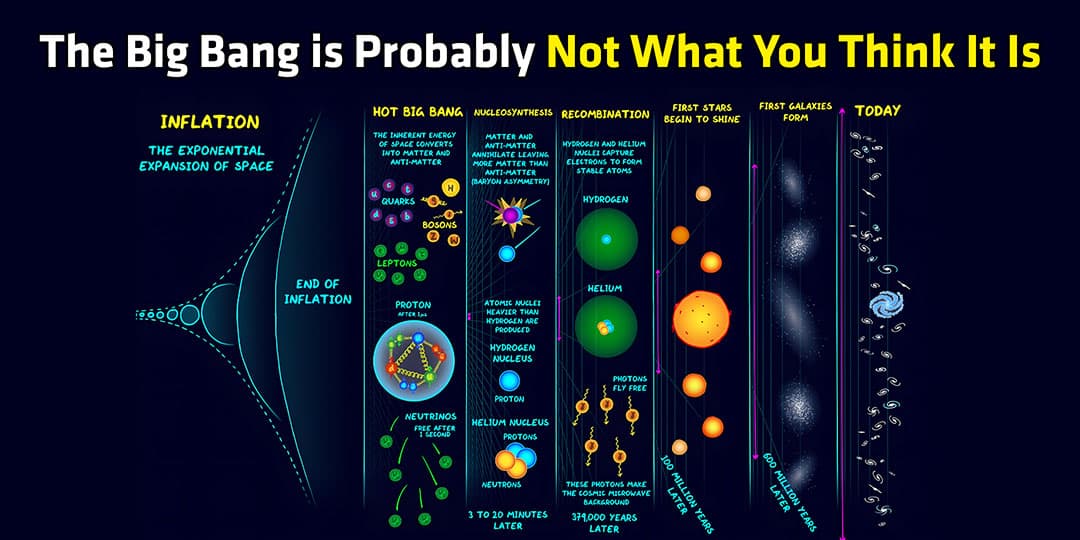
The video titled "The Big Bang is Probably Not What You Think It Is" by the channel "Domain of Science" delves into the concept of the Big Bang and aims to clarify common misconceptions about it. Here's a summary:
- Many descriptions of the Big Bang suggest that the universe exploded from an infinitely small, dense, and hot point known as the Big Bang singularity. However, these descriptions are outdated.
- The video explains that the universe began about 13.8 billion years ago when space was much smaller. This early universe expanded exponentially in a process called inflation.
- After inflation, the energy in space was converted into matter, antimatter particles, and radiation, leading to the "hot Big Bang." This is where all the matter in the universe originated.
- As space continued to expand, matter became less dense and less hot. Fundamental particles formed, followed by protons and neutrons. Later, these particles combined to form the first atomic nuclei of helium.
- After about 379,000 years, the first stable atoms formed, and photons flew freely. These primordial photons are observed today as the Cosmic Microwave Background.
- The video also touches upon the formation of the first stars and galaxies, the slowing and then accelerating expansion of space, and the presence of dark energy.
- The Cosmic Microwave Background is a crucial piece of evidence about the early universe, suggesting that everything in the visible universe was once in thermal equilibrium.
- The video clarifies that when cosmologists refer to the "Big Bang," they usually mean the "hot Big Bang," which lasted for about 379,000 years after the end of inflation.
- The video concludes by addressing unanswered questions, such as what happened before inflation, the duration of inflation, and whether time has always existed or had a beginning.
Original source