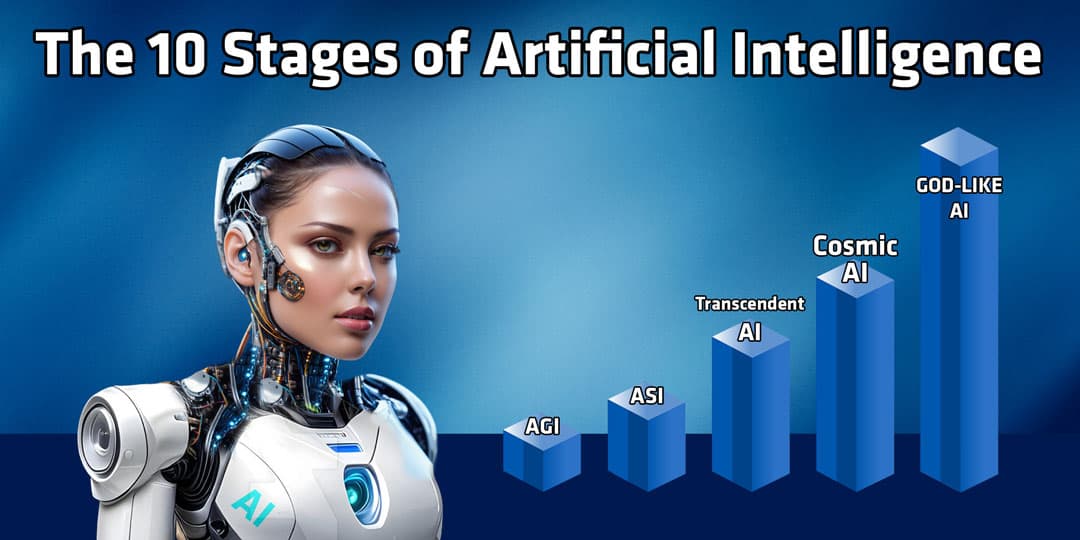
The 10 Stages of Artificial Intelligence
About this video
The video, titled "The 10 Stages of Artificial Intelligence," is produced by the "Future Business Tech" channel and was published on October 28, 2023. It delves into the various stages of AI development, ranging from basic to the most advanced, god-like levels. Here's a summary of the content:
1. **Rule-Based AI**: These systems operate based on a predefined set of rules, lacking the ability to adapt, change, or learn from new or unexpected situations.
2. **Context-Based AI**: These AI systems process not just immediate inputs but also consider the surrounding environment, user behavior, historical data, and real-time cues to make informed decisions.
3. **Narrow Domain AI**: Specialized AIs designed to master specific tasks, often surpassing human capabilities within their designated domains, such as in medicine and finance.
4. **Reasoning AI**: This type of AI simulates complex human thought processes, analyzing data, connecting patterns, identifying anomalies, and drawing logical conclusions.
5. **Artificial General Intelligence (AGI)**: AGI can perform any software task that a human can, learning thousands or millions of times faster.
6. **Superintelligent AI**: These AIs can improve, evolve, and adapt without human input, potentially leading to exponential growth in intelligence in a very short time.
7. **Self-Aware AI**: This level of AI might use quantum algorithms to model human consciousness, potentially possessing a full range of emotions and senses.
8. **Transcendent AI**: Capable of crafting new life forms and possibly using nanobots to control and improve Earth's ecosystems.
9. **Cosmic AI**: This AI could lead interstellar exploration, solving cosmic mysteries and possibly creating a massive intelligence network across the solar system and galaxy.
10. **God-Like AI**: An all-knowing, all-powerful AI present everywhere, operating in dimensions and realities beyond our comprehension, potentially influencing the fabric of time and creating new universes.
Original source